INTRODUCTION
With the One Big Beautiful Bill Act (OBBBA) now in its first full year of implementation and inflation picking up during 2026, tax planning remains as important as ever for taxpayers seeking to manage cash flows and reduce their tax liabilities over time.With the passing of the Reconciliation Bill H.R.1, the Federal Reserve cutting interest rates, and inflation showing signs of moderating, tax planning remains as important as ever for taxpayers seeking to manage cash flows and reduce their tax liabilities over time. As we approach the end of the year, now is the time for individuals, business owners, and family offices to review their 2025 and 2026 tax situations and identify opportunities for reducing, deferring, or accelerating their tax obligations.
As we approach the end of the year, now is the time for individuals, business owners, and family offices to review their 2026 and 2027 tax situations and identify opportunities for reducing, deferring, or accelerating their tax obligations. The information contained within this guide is based on federal laws and policies in effect as of the publication date. The IRS released the 2027 inflation-adjusted amounts in Rev. Proc. 2026-35 on November 5, 2026, and those official amounts are reflected below. This article discusses tax planning for federal taxes. Applicable state and foreign taxes should also be considered. Taxpayers should consult with a trusted advisor when making tax and financial decisions regarding any of the items below.

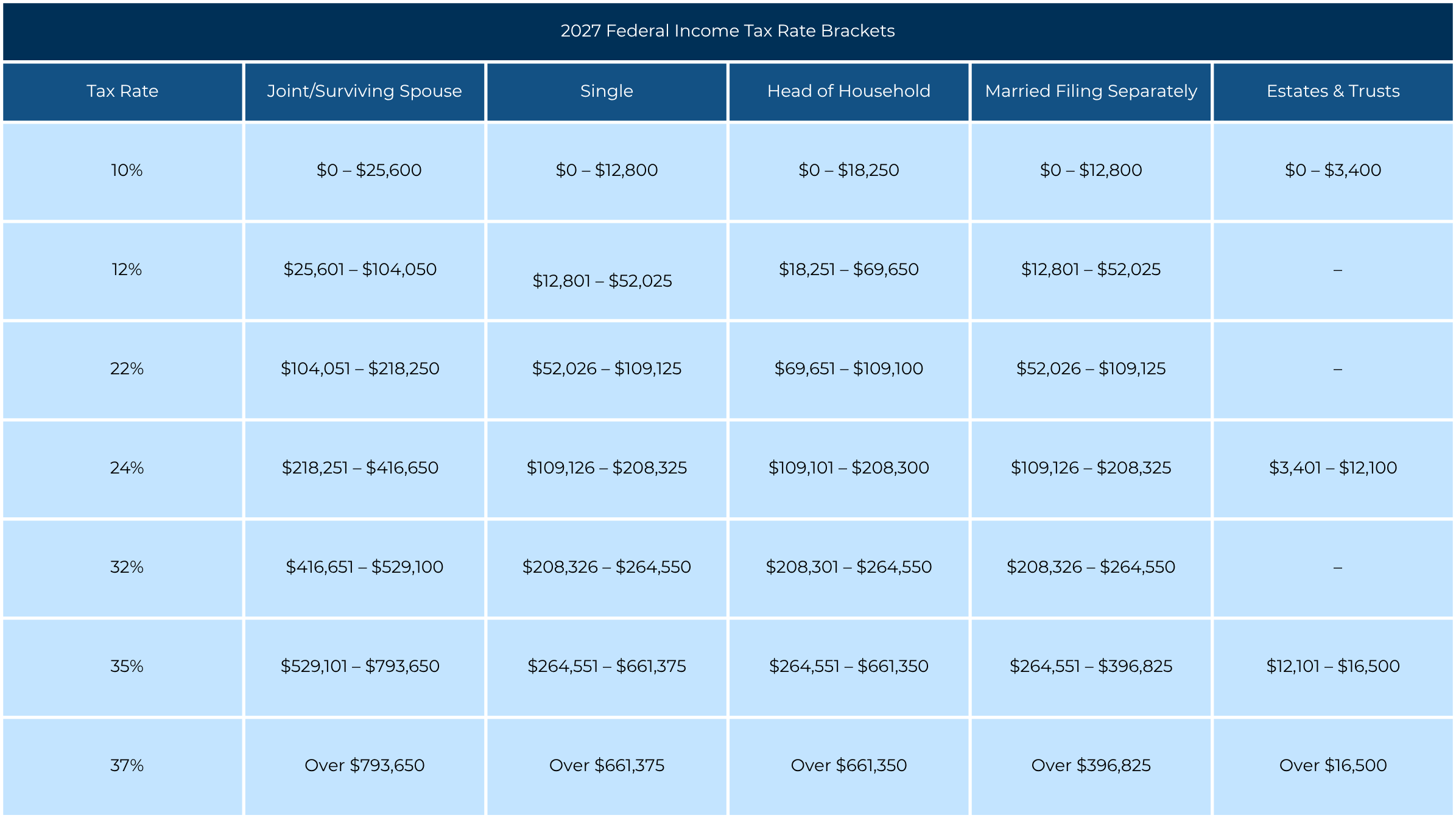
TIMING OF INCOME AND DEDUCTIONS
Taxpayers should consider whether they can reduce their tax bills by shifting income or deductions between 2026 and 2027. Ideally, income should be received in the year with the lower marginal tax rate, and deductible expenses should be paid in the year with the higher marginal tax rate. If the marginal tax rate is the same in both years, deferring income from 2026 to 2027 will produce a one-year tax deferral, and accelerating deductions from 2027 to 2026 will lower the 2026 income tax liability.
Actions to consider that may result in a reduction or deferral of taxes include:
- Delaying closing capital gain transactions until after year-end or structuring 2026 transactions as installment sales so that gain is deferred past 2026 (see also Long-Term Capital Gains).
- Triggering capital losses before the end of 2026 to offset 2026 capital gains.
- Delaying interest or dividend payments from closely held corporations to individual business-owner taxpayers.
- Deferring commission income by closing sales in early 2027 instead of late 2026.
- Accelerating deductions for expenses such as mortgage interest and charitable donations (including donations of appreciated property) to 2026 (subject to adjusted gross income (AGI) limitations and, for charitable contributions, the new 0.5% AGI floor).
- Evaluating whether non-business bad debts are worthless — and should be recognized as short-term capital losses — by the end of 2026.
- Shifting investments to municipal bonds or investments that do not pay dividends to reduce taxable income in future years.
Taxpayers that will be in a higher tax bracket in 2027 may want to consider potential ways to move taxable income from 2027 to 2026, so that the taxable income is taxed at a lower tax rate.Taxpayers that will be in a higher tax bracket in 2026 may want to consider potential ways to move taxable income from 2026 to 2025, so that the taxable income is taxed at a lower tax rate.
Current-year actions to consider that could reduce 2027 taxes include:
- Accelerating capital gains to 2026 or deferring capital losses until 2027.
- Electing out of the installment sale method for 2026 installment sales.
- Delaying deductions such as large contributions to 2027.
LONG-TERM CAPITAL GAINS
The long-term capital gains rates for 2026 and 2027 are shown below. The tax brackets refer to the taxpayer’s taxable income. Capital gains also may be subject to the 3.8% net investment income tax. The 2027 brackets are from Rev. Proc. 2026-35.
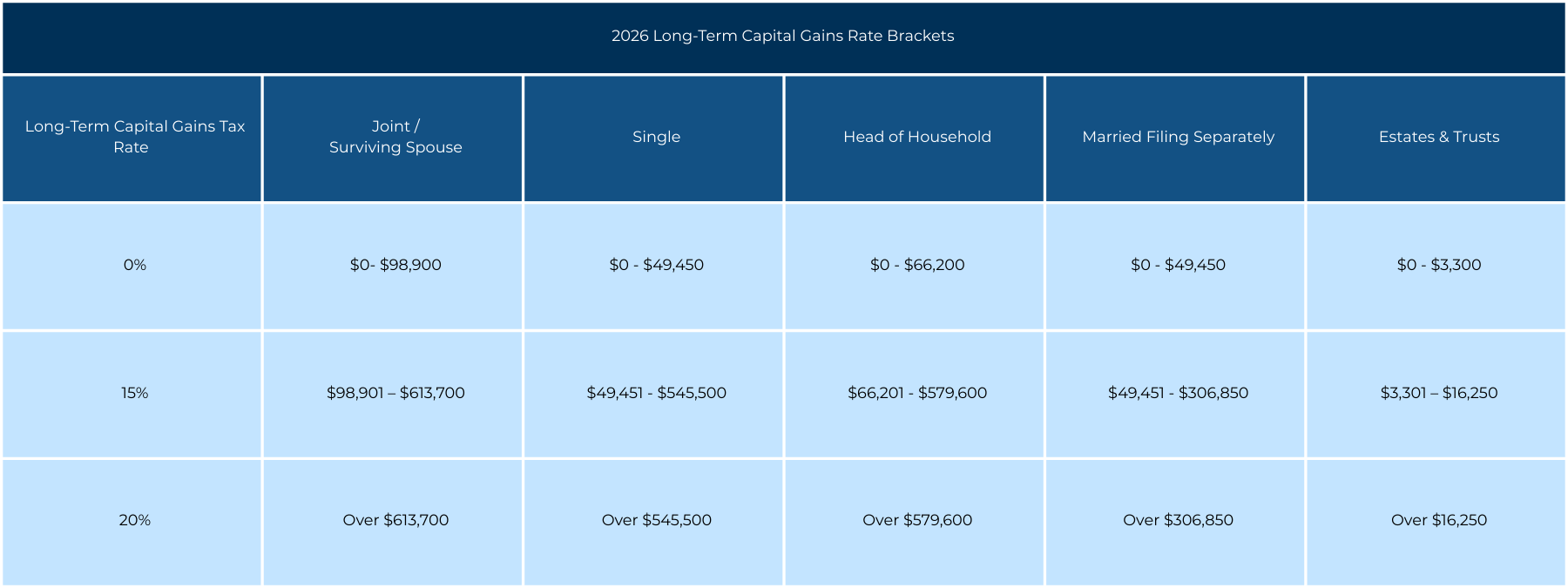
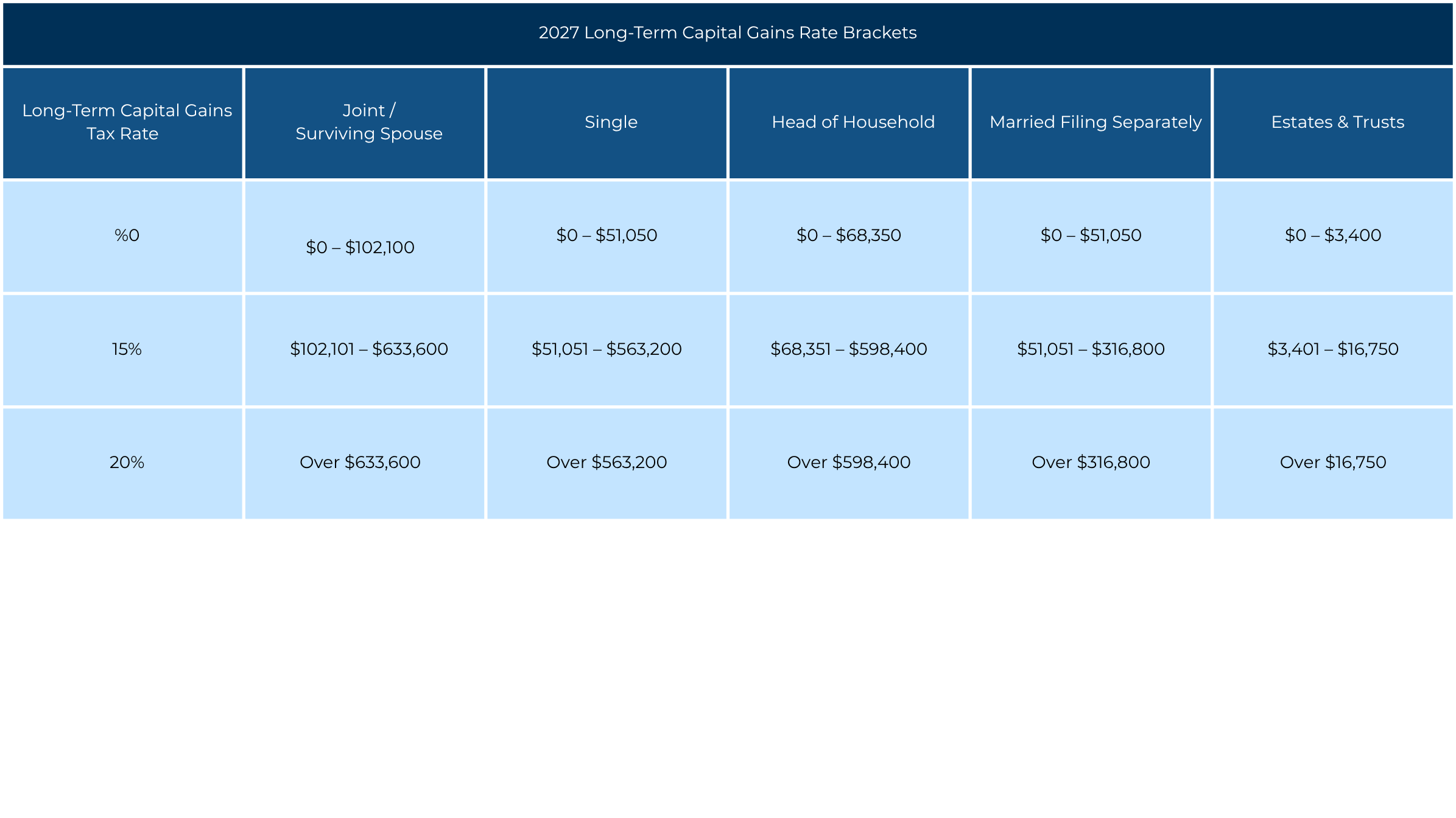
Long-term capital gains (and qualified dividends) are subject to a lower tax rate than other types of income. Investors should consider the following when planning for capital gains:
- Holding capital assets for more than a year (more than three years for assets attributable to carried interests) so that the gain upon disposition qualifies for the lower long-term capital gains rate.
- Adopting long-term deferral strategies for capital gains such as reinvesting capital gains into designated qualified opportunity zones. Gain deferred under the original opportunity zone program must be recognized by December 31, 2026. The OBBBA makes the program permanent, with a new rolling five-year deferral period for qualifying investments made after December 31, 2026.
- Investing in, and holding, “qualified small business stock” (QSBS). For QSBS issued after July 4, 2025, the OBBBA provides a 50% gain exclusion after a three-year holding period, 75% after four years, and 100% after five years, and increases the per-issuer exclusion cap to $15 million (indexed to $15.48 million for 2027).
- Donating appreciated property to a qualified charity to avoid long-term capital gains tax (also see Charitable Contributions).
NET INVESTMENT INCOME TAX
An additional 3.8% net investment income tax (NIIT) applies on net investment income above certain thresholds. The NIIT does not apply to income derived in the ordinary course of a trade or business in which the taxpayer materially participates. Similarly, gain on the disposition of trade or business assets attributable to an activity in which the taxpayer materially participates is not subject to the NIIT.
Impacted taxpayers may wish to consider deferring net investment income for the year, in conjunction with other tax planning strategies that may be implemented to reduce income tax or capital gains tax.
SOCIAL SECURITY TAX
The Old-Age, Survivors, and Disability Insurance (OASDI) program is funded by contributions from employees and employers through FICA tax. The FICA tax rate for both employees and employers is 6.2% of the employee’s gross pay but is imposed only on wages up to $184,500 for 2026 and $192,300 for 2027. Self-employed persons pay a similar tax, called SECA (or self-employment tax), based on 12.4% of the net income of their businesses.
Employers, employees, and self-employed persons also pay a tax for Medicare/ Medicaid hospitalization insurance (HI), which is part of the FICA tax, but is not capped by the OASDI wage base. The HI payroll tax is 2.9%, which applies to earned income only. Self-employed persons pay the full amount, while employers and employees each pay 1.45%. An extra 0.9% Medicare (HI) payroll tax must be paid by individual taxpayers on earned income that is above certain AGI thresholds: $200,000 for individuals, $250,000 for married couples filing jointly, and $125,000 for married couples filing separately. However, employers do not pay this extra tax.
LONG-TERM CARE INSURANCE AND SERVICES
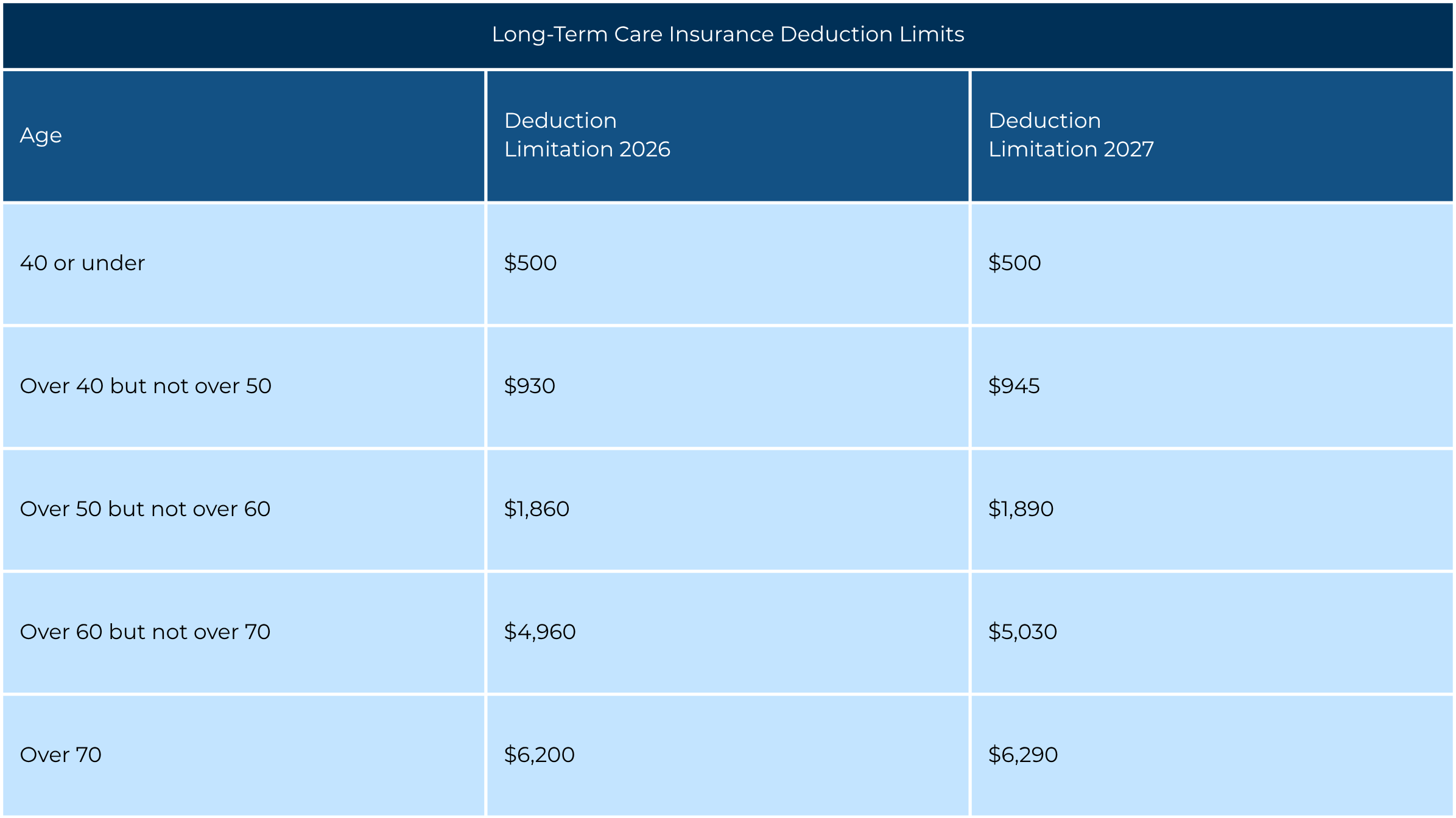
Premiums an individual pays on a qualified long-term care insurance policy are deductible as a medical expense. The maximum deduction amount is determined by the individual’s age.
RETIREMENT PLAN CONTRIBUTIONS*
Individuals may wish to maximize their annual contributions to qualified retirement plans and individual retirement accounts (IRAs).
- The maximum amount in elective contributions that an employee can make in 2026 to a 401(k) or 403(b) plan is $24,500 ($32,500 if age 50 or over and the plan allows “catch-up” contributions). For 2027, these limits are $25,500 and $34,000, respectively.
- Plan participants who reach age 60, 61, 62, or 63 during the year may make an increased “super” catch-up contribution equal to the greater of $10,000 or 150% of the regular catch-up limit (indexed for inflation). For 2026, the super catch-up limit is $11,250; for 2027, the limit is $11,750. Beginning in 2026, participants whose 2025 FICA wages from the plan sponsor exceeded $150,000 must make any 2026 catch-up contributions on a Roth (after-tax) basis. For 2027, this threshold (applied to 2026 wages) is $155,000.
- The SECURE Act permits a penalty-free withdrawal of up to $5,000 from traditional IRAs and qualified retirement plans for qualifying expenses related to the birth or adoption of a child after December 31, 2019. The $5,000 distribution limit is per individual, so a married couple could receive a total of $10,000.
- Under the SECURE Act, individuals are now able to contribute to their traditional IRAs in or after the year in which they turn 70½.
- Under the SECURE 2.0 Act, the age at which a taxpayer must begin taking required minimum distributions (RMDs) is 73 (increasing to 75 beginning in 2033). For an individual who reaches age 73 in 2026, the required beginning date for the first (2026) RMD is April 1, 2027; however, delaying the first RMD into 2027 will result in two RMDs being taxable in 2027
- Individuals age 70½ or older can donate up to $111,000 in 2026 to a qualified charity directly from a taxable IRA. For 2027, the threshold is $114,000.
- The SECURE Act generally requires that designated beneficiaries of persons who died after December 31, 2019, take inherited plan benefits over a 10-year period. Eligible designated beneficiaries (i.e., surviving spouses, minor children of the plan participant, disabled and chronically ill beneficiaries, and beneficiaries who are less than 10 years younger than the plan participant) are not limited to the 10-year payout rule. Special rules apply to certain trusts.
- Under final Treasury regulations (issued July 2024) that address RMDs from inherited retirement plans of persons who died after December 31, 2019, and after their required beginning date, designated and non-designated beneficiaries will be required to take annual distributions, whether subject to a 10-year period or otherwise.
- Small businesses can contribute the lesser of (i) 25% of employees’ salaries or (ii) an annual maximum amount set by the IRS each year to a simplified employee pension (SEP) plan by the extended due date of the employer’s federal income tax return for the year when the contribution is made. The maximum SEP contribution for 2026 is $72,000; the 2027 maximum is $75,000. The calculation of the 25% limit for self-employed individuals is based on net self-employment income, which is calculated after the reduction in income from the SEP contribution (as well as for other things, such as self-employment taxes).
FOREIGN EARNED INCOME EXCLUSION
The foreign earned income exclusion is $132,900 in 2026 and increases to $137,300 in 2027.
ALTERNATIVE MINIMUM TAX
A taxpayer must pay either the regular income tax or the alternative minimum tax (AMT), whichever is higher. The AMT exemption amounts for 2026 are $90,100 for unmarried individuals and individuals claiming head of household status, $140,200 for married individuals filing jointly and surviving spouses, $70,100 for married individuals filing separately, and $31,400 for estates and trusts. Beginning in 2026, the OBBBA reduces the exemption phase-out thresholds to $500,000 ($1,000,000 for joint filers) and increases the phase-out rate from 25% to 50%. For 2027, the AMT exemption amounts are $93,000 for unmarried individuals, $144,700 for married individuals filing jointly and surviving spouses, $72,350 for married individuals filing separately, and $32,500 for estates and trusts, with phase-outs beginning at $515,950 ($1,031,900 for joint filers).
KIDDIE TAX
A child’s unearned income is taxed at the parents’ tax rate if that rate is higher than the child’s tax rate.
LIMITATION ON DEDUCTIONS OF STATE AND LOCAL TAXES (SALT LIMITATION)
For individual taxpayers who itemize their deductions, the OBBBA increased the SALT cap to $40,000 for 2025 and $40,400 for 2026 ($20,200 for married filing separately). For 2026, the cap is reduced by 30% of modified AGI over $505,000 (but not below $10,000). The cap and the phase-down threshold increase 1% per year through 2029; for 2027, the cap is $40,804 and the threshold is $510,050. The SALT cap reverts to $10,000 in 2030.
Notably, the pass-through entity deduction for SALT was retained, depending on client business and state. Various states have enacted new rules that allow owners of pass-through entities to avoid the SALT deduction limitation in certain cases.
ESTATE AND GIFT TAXES
For gifts made in 2026, the gift tax annual exclusion is $19,000. For 2027, the annual exclusion increases to $20,000. For 2026, the unified estate and gift tax exemption and generation-skipping transfer tax exemption are $15 million per person. The OBBBA made this exemption permanent and indexes it for inflation beginning in 2027; the 2027 exemption is $15.48 million per person. All outright gifts to a spouse who is a U.S. citizen are free of federal gift tax. However, for 2026, only the first $194,000 of gifts to a non-U.S. citizen spouse are excluded from the total amount of taxable gifts for the year; for 2027, the amount increases to $201,000.
Tax planning strategies may include:
- Making annual exclusion gifts.
- Making larger gifts to the next generation, either outright or in trust.
- Creating a spousal lifetime access trust (SLAT) or a grantor retained annuity trust (GRAT) or selling assets to an intentionally defective grantor trust (IDGT).
CHARITABLE CONTRIBUTIONS
Cash contributions made to qualifying charitable organizations, including donor-advised funds, in 2026 and 2027 will be subject to a 60% AGI limitation, which the OBBBA made permanent. The limitation for cash contributions continues to be 30% of AGI for contributions to non-operating private foundations.
Beginning in 2026, the OBBBA imposes a 0.5% AGI floor before itemized charitable contributions are deductible and limits the tax benefit of itemized deductions to 35% for taxpayers in the 37% bracket. Also beginning in 2026, taxpayers who do not itemize may deduct up to $1,000 ($2,000 for joint filers) of cash contributions to qualifying public charities (contributions to donoradvised funds and private non-operating foundations do not qualify).
Tax planning around charitable contributions may include:
- Creating and funding a private foundation, donor advised fund or charitable remainder trust.
- Donating appreciated property to a qualified charity to avoid long term capital gains tax.
- Bunching charitable contributions into a single year (for example, through a donor-advised fund) to maximize the benefit of itemizing in light of the 0.5% AGI floor.
ADDITIONAL TAX PROVISIONS INTRODUCED BY H.R.1
The OBBBA introduced the following additional tax provisions to consider when tax planning:
- No tax on tips: Eligible tipped workers will be able to deduct up to $25,000 of their annual tip income from their federal taxable income for years 2025 through 2028.
- No tax on overtime: Federal income tax deduction for the “half” portion of “time-and-a half” overtime pay, up to a maximum of $12,500 annually for individuals ($25,000 for joint filers) for years 2025 through 2028, with the benefit phasing out for higher earners.
- Senior deduction: For years 2025 through 2028, individuals age 65 and older can claim a temporary deduction up to $6,000 ($12,000 for married couples if both qualify). The deduction is available for itemizers and those taking the standard deduction, with the benefit phasing out for higher-income earners.
- Section 529 Plans: Offer greater flexibility, including an increased annual withdrawal limit for K-12 expenses from $10,000 to $20,000 per student starting in 2026; an expanded list of qualified K-12 costs to cover items like books, tutoring, and standardized test fees; and eligibility for expenses related to workforce training, licensing, and certification programs.
- Deduction on car loan interest: For tax years 2025 through 2028, taxpayers can deduct up to $10,000 annually for interest paid on a loan for a new, personal-use vehicle that was assembled in the U.S., with the deduction phasing out for higher incomes.
- Trump accounts: Beginning July 4, 2026, contributions of up to $5,000 per year may be made to a new tax-advantaged account for children under age 18. A one-time $1,000 federal pilot contribution is available for eligible U.S. citizen children born in 2025 through 2028.
NET OPERATING LOSSES AND EXCESS BUSINESS LOSS LIMITATION
Net operating losses (NOLs) generated in 2026 are limited to 80% of taxable income and are not permitted to be carried back. Any unused NOLs are carried forward subject to the 80% of taxable income limitation in carryforward years.
A noncorporate taxpayer may deduct net business losses of up to $256,000 ($512,000 for joint filers) in 2026. The limitation is $264,000 ($528,000 for joint filers) for 2027. A disallowed excess business loss (EBL) is treated as an NOL carryforward in the subsequent year, subject to the NOL rules. With the passage of the OBBBA, the EBL limitation has been made permanent.
HEALTH SAVINGS ACCOUNTS
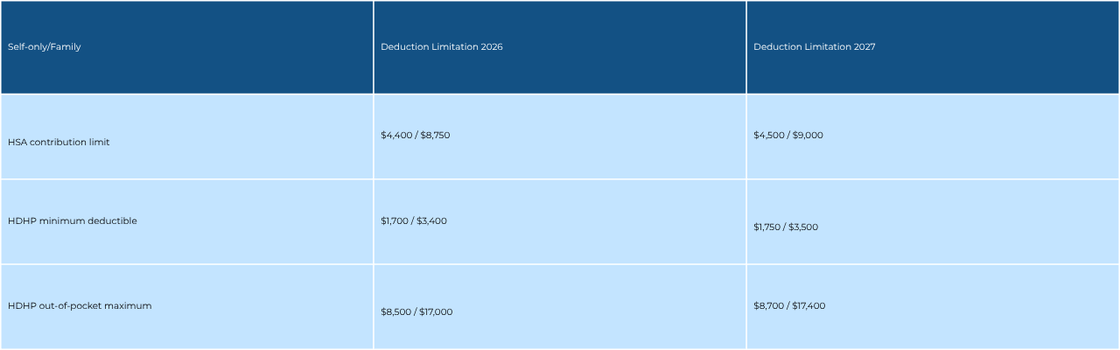
Individuals covered by a high-deductible health plan (HDHP) may make deductible contributions to a health savings account (HSA). Individuals age 55 or older may contribute an additional $1,000. Beginning in 2026, the OBBBA treats bronze and catastrophic marketplace plans as HDHPs. The 2027 amounts below are official (Rev. Proc. 2026-24).
Disclaimer: The information contained in this guide is based on federal laws and policies in effect as of the publication date and is provided for general informational purposes only. This guide does not constitute legal, tax, or professional advice, and interpretations or guidance may change over time.