

Commonly Asked Questions for Business Taxes: 2025 Filing Season Guidance
January 31, 2025

With the One Big Beautiful Bill Act (OBBBA) now in its first full year of implementation and inflation picking up during 2026, tax planning remains as important as ever for taxpayers seeking to manage cash flows and reduce their tax liabilities over time.With the passing of the Reconciliation Bill H.R.1, the Federal Reserve cutting interest rates, and inflation showing signs of moderating, tax planning remains as important as ever for taxpayers seeking to manage cash flows and reduce their tax liabilities over time. As we approach the end of the year, now is the time for individuals, business owners, and family offices to review their 2025 and 2026 tax situations and identify opportunities for reducing, deferring, or accelerating their tax obligations.
As we approach the end of the year, now is the time for individuals, business owners, and family offices to review their 2026 and 2027 tax situations and identify opportunities for reducing, deferring, or accelerating their tax obligations. The information contained within this guide is based on federal laws and policies in effect as of the publication date. The IRS released the 2027 inflation-adjusted amounts in Rev. Proc. 2026-35 on November 5, 2026, and those official amounts are reflected below. This article discusses tax planning for federal taxes. Applicable state and foreign taxes should also be considered. Taxpayers should consult with a trusted advisor when making tax and financial decisions regarding any of the items below.

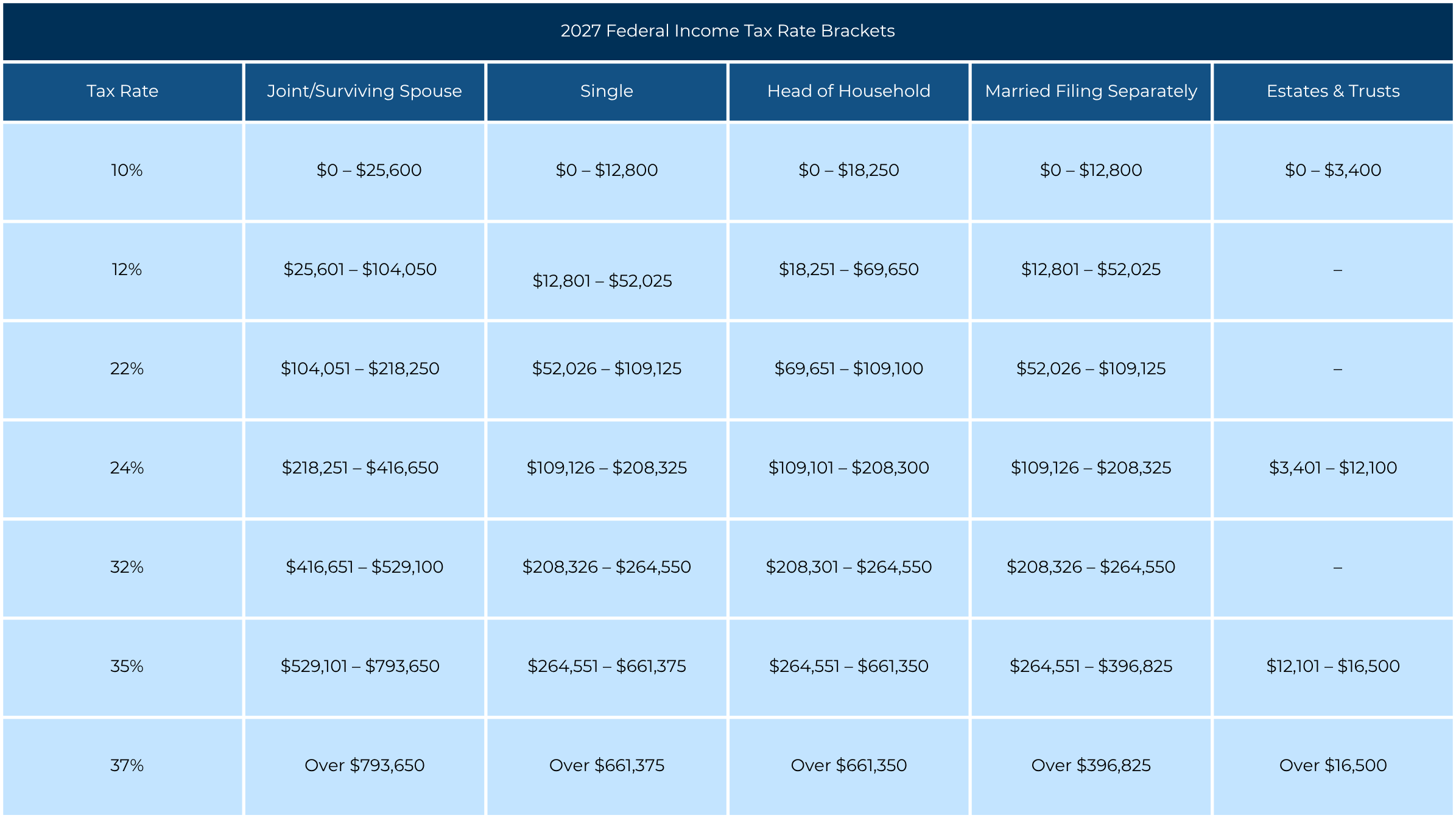
Taxpayers should consider whether they can reduce their tax bills by shifting income or deductions between 2026 and 2027. Ideally, income should be received in the year with the lower marginal tax rate, and deductible expenses should be paid in the year with the higher marginal tax rate. If the marginal tax rate is the same in both years, deferring income from 2026 to 2027 will produce a one-year tax deferral, and accelerating deductions from 2027 to 2026 will lower the 2026 income tax liability.
Actions to consider that may result in a reduction or deferral of taxes include:
Taxpayers that will be in a higher tax bracket in 2027 may want to consider potential ways to move taxable income from 2027 to 2026, so that the taxable income is taxed at a lower tax rate.Taxpayers that will be in a higher tax bracket in 2026 may want to consider potential ways to move taxable income from 2026 to 2025, so that the taxable income is taxed at a lower tax rate.
Current-year actions to consider that could reduce 2027 taxes include:
The long-term capital gains rates for 2026 and 2027 are shown below. The tax brackets refer to the taxpayer’s taxable income. Capital gains also may be subject to the 3.8% net investment income tax. The 2027 brackets are from Rev. Proc. 2026-35.
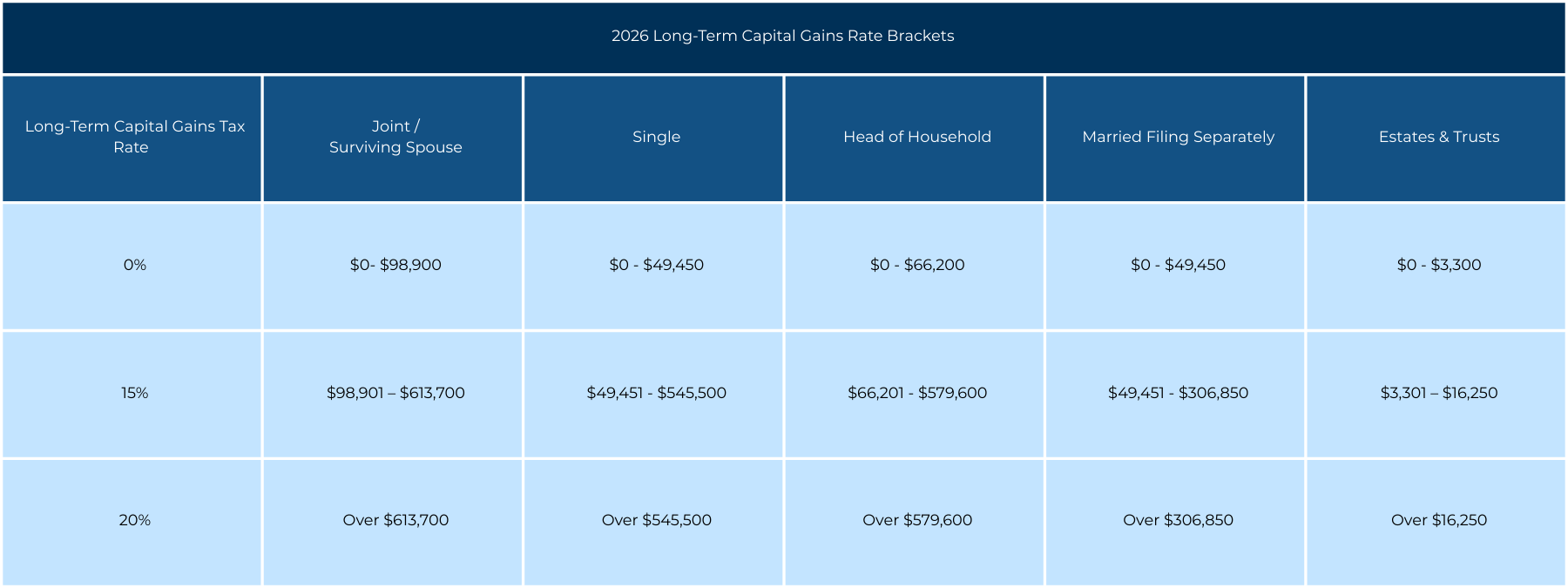
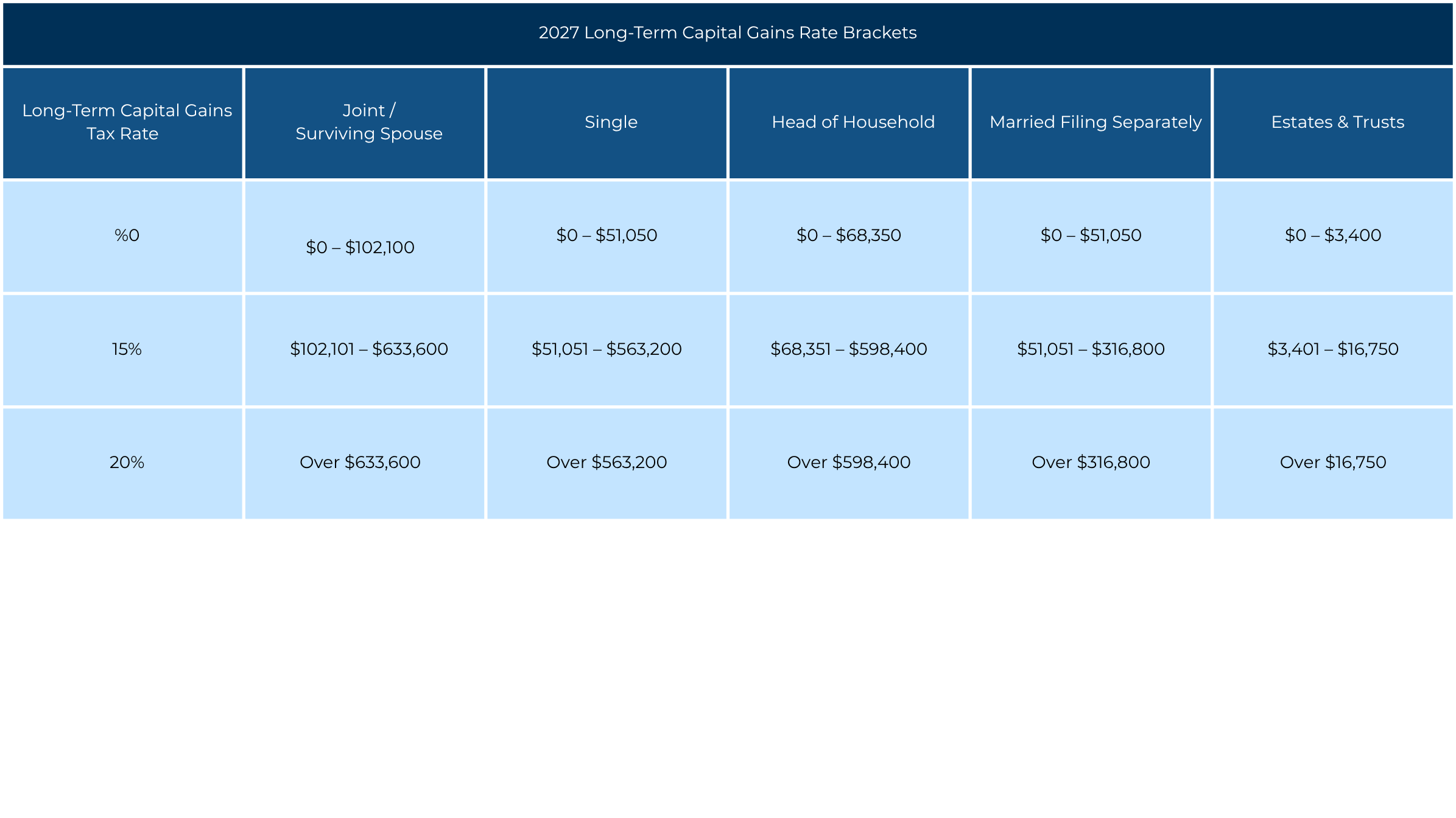
Long-term capital gains (and qualified dividends) are subject to a lower tax rate than other types of income. Investors should consider the following when planning for capital gains:
An additional 3.8% net investment income tax (NIIT) applies on net investment income above certain thresholds. The NIIT does not apply to income derived in the ordinary course of a trade or business in which the taxpayer materially participates. Similarly, gain on the disposition of trade or business assets attributable to an activity in which the taxpayer materially participates is not subject to the NIIT.
Impacted taxpayers may wish to consider deferring net investment income for the year, in conjunction with other tax planning strategies that may be implemented to reduce income tax or capital gains tax.
The Old-Age, Survivors, and Disability Insurance (OASDI) program is funded by contributions from employees and employers through FICA tax. The FICA tax rate for both employees and employers is 6.2% of the employee’s gross pay but is imposed only on wages up to $184,500 for 2026 and $192,300 for 2027. Self-employed persons pay a similar tax, called SECA (or self-employment tax), based on 12.4% of the net income of their businesses.
Employers, employees, and self-employed persons also pay a tax for Medicare/ Medicaid hospitalization insurance (HI), which is part of the FICA tax, but is not capped by the OASDI wage base. The HI payroll tax is 2.9%, which applies to earned income only. Self-employed persons pay the full amount, while employers and employees each pay 1.45%. An extra 0.9% Medicare (HI) payroll tax must be paid by individual taxpayers on earned income that is above certain AGI thresholds: $200,000 for individuals, $250,000 for married couples filing jointly, and $125,000 for married couples filing separately. However, employers do not pay this extra tax.
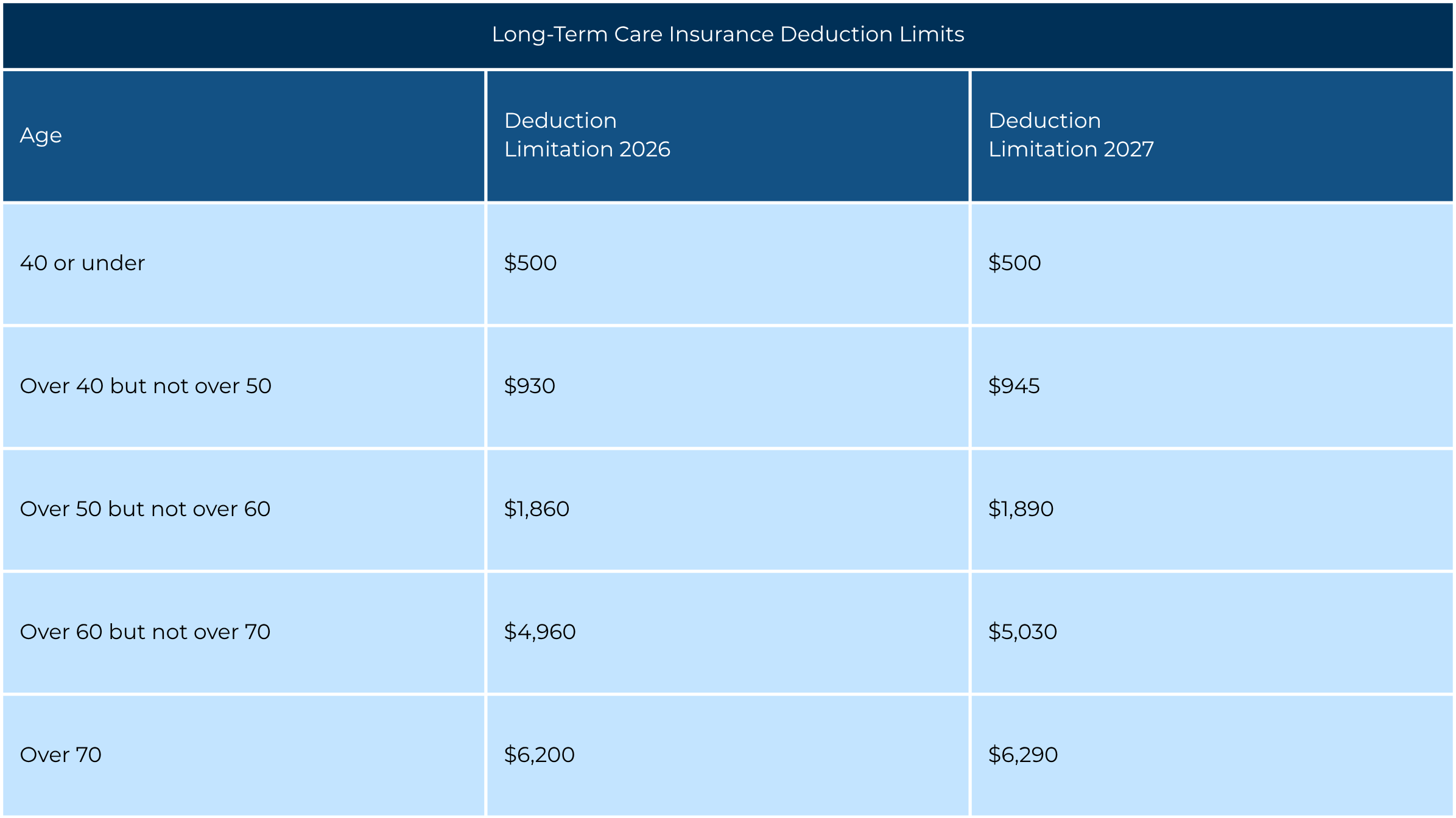
Premiums an individual pays on a qualified long-term care insurance policy are deductible as a medical expense. The maximum deduction amount is determined by the individual’s age.
Individuals may wish to maximize their annual contributions to qualified retirement plans and individual retirement accounts (IRAs).
The foreign earned income exclusion is $132,900 in 2026 and increases to $137,300 in 2027.
A taxpayer must pay either the regular income tax or the alternative minimum tax (AMT), whichever is higher. The AMT exemption amounts for 2026 are $90,100 for unmarried individuals and individuals claiming head of household status, $140,200 for married individuals filing jointly and surviving spouses, $70,100 for married individuals filing separately, and $31,400 for estates and trusts. Beginning in 2026, the OBBBA reduces the exemption phase-out thresholds to $500,000 ($1,000,000 for joint filers) and increases the phase-out rate from 25% to 50%. For 2027, the AMT exemption amounts are $93,000 for unmarried individuals, $144,700 for married individuals filing jointly and surviving spouses, $72,350 for married individuals filing separately, and $32,500 for estates and trusts, with phase-outs beginning at $515,950 ($1,031,900 for joint filers).
A child’s unearned income is taxed at the parents’ tax rate if that rate is higher than the child’s tax rate.
For individual taxpayers who itemize their deductions, the OBBBA increased the SALT cap to $40,000 for 2025 and $40,400 for 2026 ($20,200 for married filing separately). For 2026, the cap is reduced by 30% of modified AGI over $505,000 (but not below $10,000). The cap and the phase-down threshold increase 1% per year through 2029; for 2027, the cap is $40,804 and the threshold is $510,050. The SALT cap reverts to $10,000 in 2030.
Notably, the pass-through entity deduction for SALT was retained, depending on client business and state. Various states have enacted new rules that allow owners of pass-through entities to avoid the SALT deduction limitation in certain cases.
For gifts made in 2026, the gift tax annual exclusion is $19,000. For 2027, the annual exclusion increases to $20,000. For 2026, the unified estate and gift tax exemption and generation-skipping transfer tax exemption are $15 million per person. The OBBBA made this exemption permanent and indexes it for inflation beginning in 2027; the 2027 exemption is $15.48 million per person. All outright gifts to a spouse who is a U.S. citizen are free of federal gift tax. However, for 2026, only the first $194,000 of gifts to a non-U.S. citizen spouse are excluded from the total amount of taxable gifts for the year; for 2027, the amount increases to $201,000.
Tax planning strategies may include:
Cash contributions made to qualifying charitable organizations, including donor-advised funds, in 2026 and 2027 will be subject to a 60% AGI limitation, which the OBBBA made permanent. The limitation for cash contributions continues to be 30% of AGI for contributions to non-operating private foundations.
Beginning in 2026, the OBBBA imposes a 0.5% AGI floor before itemized charitable contributions are deductible and limits the tax benefit of itemized deductions to 35% for taxpayers in the 37% bracket. Also beginning in 2026, taxpayers who do not itemize may deduct up to $1,000 ($2,000 for joint filers) of cash contributions to qualifying public charities (contributions to donoradvised funds and private non-operating foundations do not qualify).
Tax planning around charitable contributions may include:
The OBBBA introduced the following additional tax provisions to consider when tax planning:
Net operating losses (NOLs) generated in 2026 are limited to 80% of taxable income and are not permitted to be carried back. Any unused NOLs are carried forward subject to the 80% of taxable income limitation in carryforward years.
A noncorporate taxpayer may deduct net business losses of up to $256,000 ($512,000 for joint filers) in 2026. The limitation is $264,000 ($528,000 for joint filers) for 2027. A disallowed excess business loss (EBL) is treated as an NOL carryforward in the subsequent year, subject to the NOL rules. With the passage of the OBBBA, the EBL limitation has been made permanent.
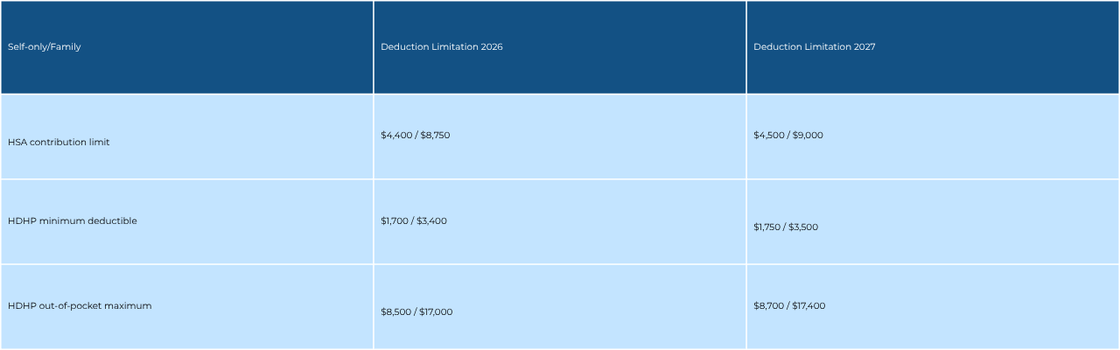
Individuals covered by a high-deductible health plan (HDHP) may make deductible contributions to a health savings account (HSA). Individuals age 55 or older may contribute an additional $1,000. Beginning in 2026, the OBBBA treats bronze and catastrophic marketplace plans as HDHPs. The 2027 amounts below are official (Rev. Proc. 2026-24).
Disclaimer: The information contained in this guide is based on federal laws and policies in effect as of the publication date and is provided for general informational purposes only. This guide does not constitute legal, tax, or professional advice, and interpretations or guidance may change over time.



© 2025 Henderson Hutcherson & McCullough, PLLC - All Rights Reserved


